Showing posts with label Stephen Harper. Show all posts

Tuesday, August 21, 2012

We Canadians


Stephen Harper said yesterday, "To succeed, what the world must become in the future is what Canada is today."

I'd like to know how he expects that to work. If every person on the planet used the same amount of energy as the average Canadian, the world would need more than 5 times the energy it currently uses in a year. Somehow, I don't think the oil sands or all the fracking and deep-sea drilling in the world will ever make that a possibility.


Not to mention it would take numerous planets for every person on just this planet to have as much space per person that we enjoy. And where's all the food gonna come from? Other than our slightly plumper neighbours to the south, we're the fattest people in the world. 

We like to think of ourselves as a fair and just people. Is it fair or just for us to expect China to reduce its emissions before we do, when per person we use over 8 times the amount of energy that they use? I'm not saying China's emissions are acceptable. They're atrocious, actually. But who are we to say that the developing world doesn't deserve to live just like we do, or that they can't burn coal to get there, just like we did? Do we really expect the developing world to continue living in poverty so that we can continue to live in excess? I don’t think so...

So what are we supposed to do in order to give the developing nations a real chance to catch up? Business as usual isn’t an option. We’ll never have the resources to support a global population that lives as we do in the developed world. No matter how much bitumen gets forced through B.C. and onto tankers headed for China and India, it will never be enough to support their energy needs. And China and India are just the newest up and comers. What about the countries that follow them? How can we possibly hope to ever support the poorest countries on Earth in their struggle to provide their citizens a decent standard of living when our own standard of living isn’t even close to sustainable?

Will standards of living across the board just average out until we’re all living substandard lives? It’s a very real possibility that that is exactly what will happen if the developed nations of the world don’t stand up real soon and pave (or better yet, de-pave) a better route. We’re responsible for 76% of the emissions in the atmosphere. The U.S. alone is responsible for 29% of the total CO2 that humanity has pumped into the atmosphere since the mid-1800s. Can we really continue to lay the blame for the mess we’re in on China? I don’t think so...

We’re responsible. It’s up to us to find the solutions for the problems we’ve caused. We have the resources - the science, the technology, the finances, and more - to change the way we live without sacrificing our quality of life, while simultaneously providing a real example for the developing world to follow. 

Instead of cutting the funding for some of our most prestigious and internationally-recognized environmental projects and funneling it into resource extraction and fighter jets, we should be at the forefront of sustainability research and education. 
Instead of building more roads and expanding our suburbs, we should be rebuilding our cities to accommodate more people in less space, with an equal or even better quality of life. 

Instead of devoting countless acres of farmland to ethanol production and unnatural, unhealthy feed for livestock, we should be driving less to reduce the need for alternative fuel sources, and we should be eating less but healthier meat (grass-fed not corn- and soy-fed).

Instead of wasting our time maintaining front and back lawns, we should spend that time converting our lawns to gardens, providing both nourishment for our families and habitat for the very species our ecosystems depend on.

Instead of thinking only of ourselves, we should be thinking of the people struggling to survive in today’s world, and the countless more people that will be struggling to survive in tomorrow’s world if we don’t start changing today.

Sunday, October 16, 2011

Call Me the Taxman

I love taxes. I really do. Obviously, I would also love to have a bit of extra money in my bank account - wouldn't we all - but I would much rather help fund health care, education, and all the other tax-dependent services that make Canada one of the best countries in the world to live in. 

I'm frequently surprised, more so during elections, at just how many Canadians jump on the anti-tax bandwagon with no real idea of how lower taxes will impact themselves and society as a whole. You can't just lower taxes and expect to receive the same level of service you received when paying higher taxes. But we don't want the same level of service, do we? No, we want more and better service, and all for a cheaper price. We want shorter wait times at hospitals and more family doctors, smaller class sizes and full-day kindergarten, better roads, more long-term care spaces for the elderly, better environmental stewardship, the list goes on and on. The problem is you can't get more for less, without sacrificing quality.

Here's how our federal tax dollars were spent in 2010:
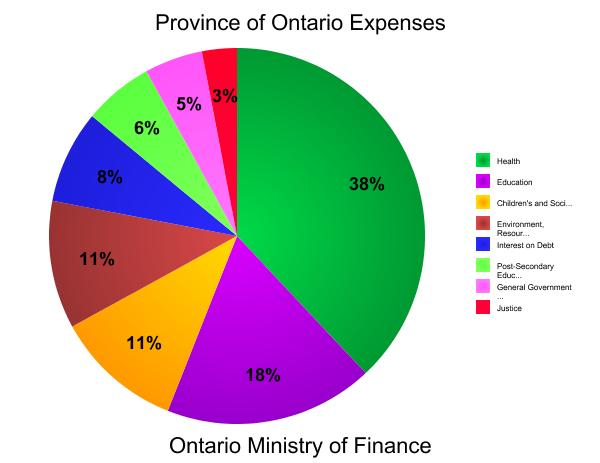
And our provincial tax dollars:


Both federally and provincially, income taxes are the biggest contributor to the tax base, followed by sales and corporate taxes.

One can argue that if taxes were spent more efficiently we could afford to lower them. As Rob Ford, the mayor of Toronto has wonderfully demonstrated, this "gravy" is very much non-existent. If Toronto, the wealthiest city in Ontario, can't cut spending without cutting services like libraries and police, it's doubtful than many other municipalities, if any at all, can find this so-called "gravy," either.

Statistics show that the George W. Bush era of tax cuts in the Untied States has contributed more to the country's debt than the economic downturn, recovery measures (bailouts and economic stimulus), and the war for oil (oops...I mean on terrorism). The fact that economists denounce the reduction of the GST in Canada (which voters support), and support the HST (which voters denounce) is truly worrisome and indicative that Canadians' attitudes toward taxes are beginning to mirror those of our neighbours to the south. 

Center on Budget and Policy Priorities, based on estimates from Congressional Budget Office
Taxes are an investment in our future - in our children's and grandchildren's futures. Yet taxes have been continuously reduced in Canada for the past decade, while our provincial and federal deficits and debts soar. Health expenditures, as seen above, require the most funding from the tax base, and their share of the pie is only going to grow. Our society is aging, and our youth are experiencing more health problems now than they have in the past century. As health care costs consume more and more of our taxes, are we going to be willing to cut spending on education, justice, social programs, national security and sovereignty, and other essential services to keep up? I doubt it, but without a healthier tax base, that's precisely what will happen.

We need a better tax system. Corporations and the wealthy need to pay more. Carbon taxes should replace a good portion of income taxes. The GST needs to be returned to an appropriate level. The reduction of the GST (which reduces government revenue by over $13 billion a year) was nothing more than a bribe - one of Harper's many ways of buying votes. Any politician with half a brain knows that reducing sales taxes is not good economic policy. It's not only insulting, but it's downright deplorable that the Prime Minister of our country misleads Canadians and promotes political and economic ignorance by promoting flawed policies simply to improve his chances at election. Ask yourself this: who does sales tax reduction really help? It doesn't do much to help the average Canadian who can't afford to go shopping at the mall every week. A 2% reduction in sales tax does, however, mean a lot to an already under-income-taxed wealthy Canadian who can afford a $1000 pair of shoes and a $100 000 luxury sedan. Reductions in corporate and sales taxes help the rich more than the poor. Period.

Best Buds
Income disparity (the gap between the rich and the poor) is now growing more quickly in Canada than in the United States. While the average Canadian is very lucky to enjoy a better standard of living than the average American, as our social and economic policies continue to mimic American policies, our standard of living is quickly joining the Americans' in a race to the bottom. 

According to Alex Himelfarb, Director of the Glendon School of Public and International Affairs, at York University, former Clerk of the Privy Council and Secretary to the Cabinet, "It is time to make some hard choices about the Canada we want, about what services we see as essential, about how much inequality we are prepared to tolerate, about our willingness to take back the future."

Thursday, September 29, 2011

PMO Meddling in Ontario's Provincial Election

Two members of the PMO have made the news this week for interfering in the Ontario provincial election.


Nigel Wright
Stephen Harper's chief of staff, Nigel Wright, hosted a fundraiser for a Toronto PC candidate in his Toronto home. Oddly enough, it was Wright who authored the memo from the PMO urging members of the Conservative caucus to avoid "becoming the story" in the 4 provincial elections that are underway this fall.


Dean Del Mastro, Harper's parliamentary secretary, actually commissioned a poll in his Peterborough riding. While Del Mastro claims that his poll wasn't conducted with any intention of affecting the election in his riding, it's pretty hard to believe that a politician isn't aware of the impact that polls can have on the voting process. The two questions posed in Del Mastro's poll were undeniably partisan:


Dean Del Mastro
“Given that jurisdictions like the United States and Europe have invested billions of dollars trying to create green jobs with disappointing results, do you believe that the $7 billion Samsung deal will create 16,000 jobs in Ontario?”


“Given that families and seniors are struggling today in Ontario, do you support eliminating HST from energy bills as well as income-splitting for families to reduce their provincial tax burden?”


In addition to his poll, Del Mastro has appeared at numerous functions in support of Peterborough's Conservative candidate. He has also attacked the Liberal Party of Ontario's platform on his Facebook and Twitter pages. 


Stephen Harper and Rob Ford
on August 2, 2011
Clearly, the PMO doesn't practice what it preaches. Harper himself set the stage for these egregious interferences in political politics when he attended a barbecue hosted by Rob Ford in August. After applauding Rob Ford's "accomplishments" as mayor of Toronto, and patting himself on the back for cleaning up the "left-wing mess federally", Harper expressed his hope to "complete the hat trick" in the October 6 Ontario provincial election.


What really bothers me is that Harper didn't advise his caucus not to involve themselves in this fall's provincial elections. He basically told them to interfere all they wanted - just to be sneaky about it to avoid "becoming the story". So much for that, eh?

Wednesday, September 28, 2011

Stephen Harper - The Anti-Robin Hood

Tony Clement and Stephen Harper
Tony Clement's slush fund is once again making a splash in the news. After days of refusing to answer questions during Question Period in regards to the $50 million that was misspent in his riding of Parry Sound-Muskoka for the 2010 G8 Summit, Clement has announced that he will field questions in a parliamentary committee. Let's forget for now that the committee consists of 7 Conservatives, 4 NDPs, and 1 Liberal. What I want to talk about is Stephen Harper.

I've been hearing a lot from Conservative supporters that this $50 million isn't that big of a deal. After all, remember AdScam? I do. $3.75 million in misappropriated funds. Doesn't seem like that much money compared to $50 million. Harper rode the AdScam wave all the way to the PMO. Remember his cries for transparency and integrity in government? Where are they now? Paul Martin launched a full inquiry into the sponsorship scandal. I don't see Harper following suit and giving Canadians the transparency and honesty that they deserve, or that he promised.


"Oh, but every riding received stimulus money to help weather the recession." True. The average riding received between $15 and $20 million in stimulus funds. In addition to the $50 million in G8 funds, Parry Sound Muskoka received $42 million in stimulus funds, over twice the national average, for a grand total of $92 million in government funding in 2010 - over 4 times the national average.

Now, let's look at the amount of money that other cities have received in summit funding in the recent past. In 2002, Kananaskis, Alberta hosted a G8 summit. The city received about $5 million in funding. In 2001, Quebec City hosted the Summit of the Americas and received $4.5 million in funding. So why, then, did Parry Sound-Muskoka need $50 million? Plain and simple: it didn't. Parry Sound-Muskoka is a riding with a very healthy tax base. Cottages costing millions of dollars tend to contribute nicely in the form of property taxes. 

Just a small part of Muskoka's "Millionaire's Row"
The fact is: this $50 million could have been spent in a riding that truly needed the help. But Harper chose to take taxpayer's money and funnel it into a friend's riding that is already wealthier than most in Canada.


Harper's Economic Action Plan: Take from the poor - Give to the rich.